Sep
30
2008
New Smyrna Beach, FL set a new record for most shark attacks in a year at 23. In case you don’t think that’s a lot of shark attacks, consider that in 2007 there were 74 shark attacks globally! My question is why is anyone out there surfing at all?! The Fear Beneath reports on the last attack. Although with three months left in 2008, I doubt that the sharks of New Smyrna will rest on their laurels.
Sep
15
2008

Now someone please tell me that after 22 shark nips, bites, and attacks in one year, why would anyone be out swimming, wading, or surfing the waters of New Smyrna Beach?! Anyway, Swim At Your Own Risk reports the 22nd attack of the year. “According to NewsJournalOnline a 32-year-old tourist earned the honor of becoming the 22nd shark bite victim of the year in Volusia County today, tying the previous record set in 2001.” (image: http://SwimAtYourOwnRisk.com)
Sep
10
2008

Two surfers have been attacked by sharks in the past week. The photo above is of a surfer’s board in Lompoc, CA north of Santa Barbara. Kyle was surfing Surfer’s Beach and saw a Great White Shark circling him! He got off his board and used it as a shield, fins out, between him and the shark. The shark chomped the board and left a reminder of what Great Whites can do. Researchers are estimating it to be a Great White between 14-16 ft in length. The pictures are unbelievable.
There was also an attack in Kaaawa, Hawaii on the east side of Oahu at Crouching Lion’s.
“The shark attack happened at about 5 p.m. Tuesday about 300 yards offshore at a surf spot known as Crouching Lion. 40-year-old Todd Murashige told emergency officials he was sitting on his surfboard when he was attacked. Murashige paddled himself to shore accompanied by another surfer. He was taken to Queen’s Medical Center in serious condition.”
The injury to Murashige is reported to be serious. It is the second attack at Crouching Lion’s in just over a year.


Sep
09
2008

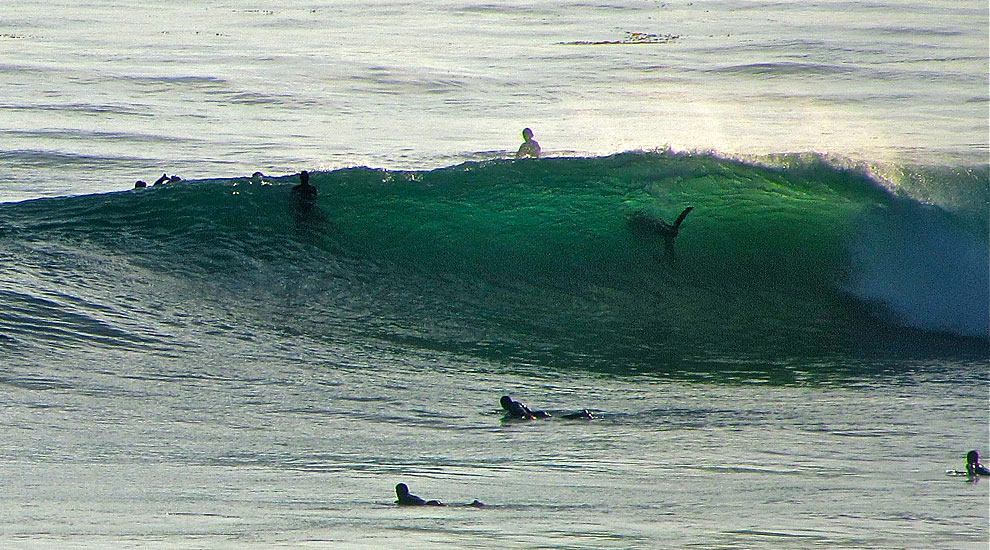
Here’s a photo from a couple days ago of a surfer blasting the top of a wave at glassy, beautiful Ocean Beach, San Francisco… oh wait, there’s a fin in the background?!
Ocean Beach, San Francisco is in the Red Triangle, or in case you haven’t heard is one of the sharkiest places in the world. There have been a slew of recent great white sightings at Ocean Beach and Stinson Beach, further north in Marin. Stinson Beach was closed over Labor Day Weekend because of shark sightings.
Sep
04
2008

The image above is a aerial photo of New Smyrna Beach, Florida. The dark shapes in the water are Blacktip and Spinner Sharks. New Smyrna is now officially the shark attack capital of the world. It has registered 19 attacks in 2008 alone!!! There were 74 unprovoked attacks globally in 2007 (image and statistics courtesy of the International Shark Attack File). The 19th attack at New Smyrna Beach was the 4th attack in 2 weeks at the beach. Concerned? I think I might be. Although I’m a bit more puzzled as to why people keep swimming and surfing there. To give you an idea, the attacks so afar at New Smyra Beach in 2008 alone is 1/3 of the global attacks of 2007! I posted earlier on statistics of the risk of death from a shark attack (pretty much nill), but I wouldn’t discount a risk of an attack in New Smyrna.

5ones and the Fear Beneath both report on the attacks. Check the Fear Beneath for more detailed reports on the attacks. Too bad for surfers in the area because the Altantic is sending a slew of hurricanes there way right now. Meanwhile popular surf spots in California’s Red Triangle have had a string of shark sightings including sightings at Ocean Beach, San Francisco and Stinson Beach, Marin County. Not hugely surprising considering it is the Red Triangle.
Here’s a photo a photographer, Kem McNair, caught earlier this year of a spinner shark jumping out of a wave with a surfer on it at New Smyrna Beach.

Jul
21
2008

An amateur photographer, Kem McNair, caught a photo of a Blacktip “Spinner” Shark catching some air sharing a wave with a surfer.
Kem McNair, who had finished surfing at New Smyrna Beach, Florida, before taking three images of the shark, shot in under a second, said: “I saw something in the background and I thought, ‘What was that?’. I looked back at the display on my camera and there it was — a spinner shark.”
Blacktip sharks, known as spinners because of their habit of leaping out of the water, are common in the shallow coastal waters and estuaries of Florida. The majority of shark bites in the state are blamed on the species and New Smyrna beach is notorious for attacks, this year the toll has already reached twelve.
“We see them all the time,” says McNair of the 6ft specimen he captured on film, ” if you ride a wave and the water is clear you may see two or three sharks in the length of one ride…”
Interestingly enough, New Smyrna Beach is ranked as one of the worst in the world for shark attacks. And it’s those Spinner sharks that are most likely to come in for a taste…
Here’s a link to McNair’s site with the three photo sequence of the shark jumping.
Jul
14
2008
Yes, the sharks have returned. Well, they were actually always there. Three fatalities (San Diego and two in Mexico) and a fatality in the Bahamas have whetted the media’s appetite for the sensational and dark nature of the Ocean’s beast. This past week there was an attack on a swimmer on the Isle of Palms in South Carolina. It was the second attack of the year and resulted in minor injuries, but has fed the media’s shark frenzy. Sightings of one or more large great whites off Martha’s Vineyard in Massachusetts have also set off the media. There has not been a great white attack in Massachusetts since 1936, but that hasn’t stopped the media from printing headlines like, “‘Jaws’ returns to stalk Martha’s Vineyard.” In spite of the article’s headline, it goes on to say that there’s been a couple confirmed sightings of sharks or a dorsal fin, but no attacks. In the 19 years of the shark fishing tournament, no one has caught a great white.
In spite of the media’s hype, shark attacks and related fataties are still excedingly rare. Check out our post on your chances on dying from a shark attack in relation to other causes of death. Point is, you’re still more likely to die of a collapsing sand-hole incident than from a shark attack, even if you are a surfer! Here’s a link to wikipedia’s entry that lists all fatal, unprovoked shark attacks.
Jun
24
2008
There’s no question there was some serious fall out from a series of three shark attack within one month in ZIhuatanejo, Mexico (two attacks were fatal). Theories abounded, locals went on a shark killing spree, and media flocked in. Everything from La Nina to Mexican drug runners were blamed. The area which relies on tourism has most likely taken and will continue to take a big hit. LA Times wrote an article that summarizes the incident and responses well.
Outside Magazine Blog published a post that suggests that some locals in the area and “critics” have called into question whether the surfers are to blame noting a certain “reckless selfishness” that surfers display by surfing in areas that might have sharks. Well, I couldn’t find any other reference in any media source that cited locals stating this. As to “critics,” who exactly are these critics? Aside from factual reliability of this statement, it ignores the fact that the last shark attack in the area (in Nayarit, a state 200 miles away!) was in 1972!!! That ranks it as one of the safest surf areas in the world for shark attacks. So to suggest that surfers are knowingly paddling out into shark ridden areas is absurd, as of the attack in April it had been 35 years since there had been an attack within 200 miles!
Shark attacks are nothing new, in fact it’s what sharks do and what they will always do. They have to eat, occasionally they mistake one of us for prey. It’s unfortunate and has tragic results, but also extremely rare (there’s an average of 3.8 fatalities annual worldwide and only 1 in 2007). It shouldn’t keep people from the water although when attacks do happen in certain areas, surfers and swimmers should exhibit caution. Surfline lists a few precautions:
Here are a few things you can do that will reduce the likelihood of an encounter. Don’t surf those areas that are utilized by grunion during their spawns - larger predatory fish will frequent these areas. Don’t surf after sunset and before dawn - sharks are known to migrate towards land at night. Don’t surf a beach where a recent shark encounter or attack has occurred - this one is obvious, the shark could still be in the area. Don’t surf near pinniped haul-out sites - they are a primary prey species for adult white sharks.
Jun
16
2008

The Sun reports that the recent shark attacks in Mexico may be due to sharks in the area acquiring a taste for humans by feeding on bodies dumped in the ocean by the Mexican mob. The Sun reports that local authorities are investigating this theory. Really? The story doesn’t validate whether the Mexican mob has in fact dumped “hundreds of bodies” in the ocean or whether it’s been witnessed that sharks either feed on these bodies or that they have been found with shark bites in them. If there were in fact hundreds of bodies dumped, then you would think that a few would wash a shore or be found by fisherman. On my trip to Zihuatenajo in April weeks ago, I was surprised by the presence of armed Mexican marines in the tiny surf town of Troncones. There were also roadblocks with heavily armed Mexican solders up and down the highway suggesting some issues with the drug trade. But I never heard anything about bodies being dumped in the ocean. You’d think a publication like the Sun would want to check their facts and get real source not a couple of guys in a bar.
Outside magazine published a blog post, suggesting maybe surfers were to blame. In spite of all the media coverage and the hype, the risk of death from a shark attack is pretty much insignificant. Worldwide there’s an average of 2.7/year for all surfers, swimmers, and beachgoers. Pretty slim considering how people are out there in the water.
Jun
11
2008

Shark Shield, the once touted solution to our shark fears, leaves us further in doubt about our shark-resistant future. I posted a while back about a test of theirs that went as wrong as it could go when a female white shark swallowed the device whole! (post) In principle the Shark Shield is simple. Sharks use a very sensitive organ in their snout to detect minute electrical fields generated by their prey’s muscle movements conducted through the water (or in our case, the surfer’s muscle movements). Shark Shield emits an electrical field (conducted through the salt water) that would in theory startle and repel sharks. Reasonable thinking. [more after jump and a video on the device]
Continue Reading »