Mar 13 2009

Diver Fights and Kills 12 ft. Tiger Shark (Photos & Video)
Published by under Sharks,Videos

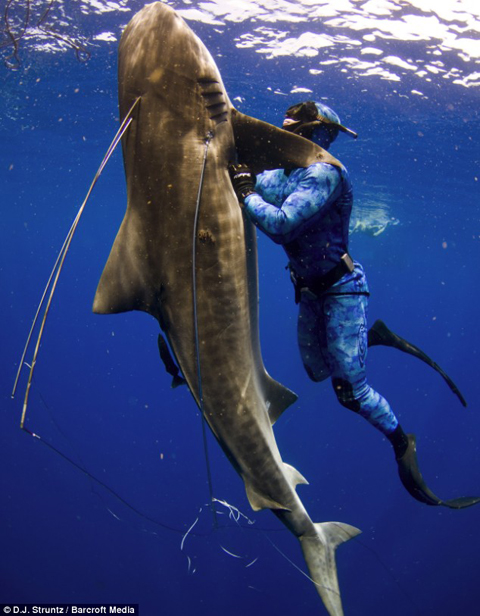
Diver Craig Clasen grapples with a 12ft tiger shark to protect a friend

Diver Craig Clasen grapples with a 12ft tiger shark to protect a friend

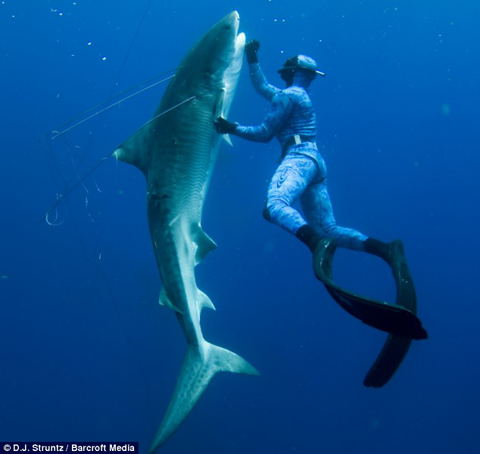
Craig Clasen was hunting yellow fin tuna with fellow fisherman Cameron Kirkconnell, photographer D.J Struntz (DJ Strunz’s portfolio) and film maker Ryan McInnis in the Gulf of Mexico when a 12 ft. Tiger Shark aggressively approached and circled Ryan McInnis in deep waters south of the Mississippi River’s mouth. Regarded by many as two of the world’s best free diving spearfishermen, Craig and Cameron have come into contact with thousands of sharks.

Craig Clasen immediately swam to his friend with his spear gun.

‘I positioned myself between Ryan and the shark and I tried to watch it for a second, hoping it would pass us by,’ explained 32-year-old Mr Clasen.

‘I noticed that the shark was getting tighter and tighter and just kept trying to get a back angle on us and behaving in an aggressive manner.

‘The shark made a roll and looked like it was going to charge us so I just went ahead and took the conservative route and put a shaft through its gills.

‘Cameron and I have been around sharks for years and we all have a lot of experience with them but this encounter had a different feel to it.

‘Down in my core I really felt the shark was there to feed. I didn’t want it to come to that.’

Craig spent nearly two hours wrestling with the giant 12ft shark, spearing it seven times and even attempting to drown the beast before eventually finishing it off with a long blade knife.
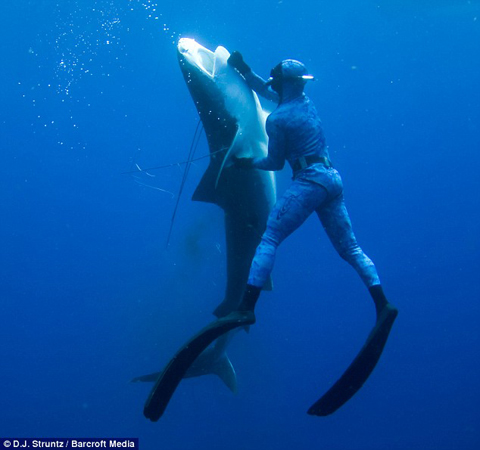
Craig Clasen uses his knife to kill a 12 ft. Tiger Shark

Craig Clasen uses his knife to kill a 12 ft. Tiger Shark

‘Once I shot it in the gills I felt a moral obligation to finish the job,’ says Craig.

‘I didn’t want it to go on any longer than it had to. I shot the fish like I would do any other fish and worked it up closer and did my best to kill it as humanely as possible.

‘I speared it in the gills which I knew would kill it and from that I tried to put a shaft into its brain as quickly as possible.

‘I shot it six times in the head with a spear and I wasn’t having much luck – it was a slow drawn out process.

‘Sharks are so resilient and so tough from millions of years of evolution they are just survivors.

‘The best way and quickest way to finish the job and kill the shark and recover it was to get a rope around its tail, drag it from the back of the boat and attempt to drown it.

‘In the end we had put a knife its skull once I got lose enough to it and use a long blade knife even after trying to drown it.’

Story at DailyMail.co.uk Transworld Surf


UPDATE:

When I wrote this post over a year ago, I had no idea it would garner such a big reaction and so strong opinions. Ryan McInnis, the photographer at the incident, recently discovered the post and left a comment and his reaction. As for everyone else, please keep it civil. I will delete any flame comments, so far I’ve had to delete multiple comments. Ryan, thanks for your comment and for clarifying the story.

Here’s Ryan’s comment reprinted from below:

Wow… I stumbled across this thread today and am amazed that 2 years after the incident there is still discussion about it. I’ll try to be brief:
– Spearfishing is the most ethical and sustainable way to provide seafood for oneself. We were there to take tuna and wahoo.
– We were also there to capture video and images of a new product line for a company. Businesses need promotional material of their gear in action.
– There was a combined 100 years of ocean experience in the water at the time this happened. 2 of us are from North Carolina where sharks are present on EVERY dive. I personally have spent hours outside a cage with big great whites. In other words, we know sharks.
– Our boat was over 50 yards away when this happened, getting out of the water would have been the first option of course. But this event happened faster than the boat could get to us, and swimming away from an aggressive sharks is the last option.
– Once the decision had been made and the first shot fired (which was a mortal shot), there was no other choice but to finish the fish. They are tough and yes it took many more shots to end the struggle. We took pictures and video because the initial danger was over.
– The mood was more than somber and the event cast a dark shadow on what was otherwise a great trip. Killing a shark is an awful thing, and this was the first time in all of our years that it had been necessary.
– One of us was working on a story with Outside Magazine, they ran a photo as ‘what you hope never happens’… then the national media caught it (10 months later) and before we knew it wild rumors and lies about the event began to spread.
And here I am today, still trying to explain why this happened. What got lost in all of this is that I was nearly attacked by a fish twice my size and my buddy came to my rescue. It’s no different than a grizzly bear in Alaska being shot for charging a hiker. It’s terrible but it’s part of sharing the outdoors with the natural residents.
We don’t hate sharks but we do love spearfishing. We did not benefit from this event at all, quite the opposite.
RM, underwater videographer

Check out all the latest shark news on Surftherenow.com here.
262 responses so far

Mar 01 2009

Teenage Surfer Attacked by Shark in Sydney: Third Attack in Less Then Three Weeks

Published by under Australia,Sharks

They say bad things happen in groups of three. Seems like this has been the case with shark attacks in the last year. In April last year, Zihuatanejo was hit by a string of shark attacks over the course of three weeks including one fatal attack (link).

Now, sharks are striking fear in the surfers and swimmers at Sydney. A 15 year old boy has been mauled by a shark on Sydney’s northern beaches, in the third shark attack in Sydney in less than three weeks. (Times UK Article)

The boy was surfing off Avalon Beach early on Sunday morning when the shark attacked, inflicting severe lacerations to his upper left leg. He underwent four hours of surgery to repair the injury (link).

Nick Miller from the Avalon Surf Lifesaving Club said the surfer was in the water with his father when the shark attacked.

“The father and son were out surfing this morning,” Mr Miller told ABC Radio.

“It got him around the top of his leg and his calf muscle and the father came in and dragged him in. ”

Witness Dylan Cram told Sky News: “I saw the two of them paddling in and frantically screaming ‘shark’. It was a pretty bad thing to witness.”

Other beach-goers said the boy, who had bites to his calf and thigh, was able to walk out of the water. His father used his t-shirt as a tourniquet while an ambulance was called, and he was airlifted to Royal North Shore hospital.

A hospital spokesman said he had wounds to his upper left leg, and he was in a stable condition. His leg had not been severed.

It is believed the shark is around five to six feet, but it is not yet known what type of shark it is. Helicopter searches of Avalon and neighboring beaches, which are popular with Sydney surfers have failed to spot the shark.

Richard Andjelkovic of Sydney Surf Lifesaving told The Times the number of shark sightings on Sydney beaches had increased recently. “Last weekend we closed a large number of beaches after a shark was spotted,” he said. “The number of shark sightings have been up in the last while. We’re not sure why, it might be because the waters are cooler and there are a lot more fish around.”

Nearly three weeks ago, navy clearance diver Paul de Gelder was mauled by a 2.7-metre bullshark in Sydney Harbor, causing him to lose a hand and leg.

Just a day later, in the first attack off Bondi beach in nearly 80 years, 33-year-old surfer Glenn Orgias was attacked by a 2.5m great white that shook him and nearly severed his left hand.

Check out all the latest shark news on Surftherenow.com here.

One response so far

Feb 02 2009

Is Baja Safe Again?

Published by under baja,Mexico,Travel Tips

The Most Compelling Reason for a Baja Trip

The Most Compelling Reason for a Baja Trip

Photo: Mike Marincovich (Surfline)

The glory for surfer and their love affair for Baja ended abruptly in the fall of 2007 with repeated violent car jackings and a startling increase in violence and killings in Tijuana by drug gangs. The two were not unrelated. Baja fell off the map for most of us and most likely the magical beach breaks and points of Baja were left empty through 2008. Surfline discusses whether it’s safe to return. The short of it: not really. It’s still risky, but can be done when done right. Surfline article quoted below:

Dedina cautions, however, that this doesn’t mean that surfers should not still be vigilant. Dedina also warns that just because Mexican police seem to be helping in the border corridor now, that doesn’t mean surfers should ignore the long history of corruption tied to police in the region. “Most police officers are not our friends,” Dedina said. “Just this past weekend, a WiLDCOAST staffer asked a Tijuana police officer for directions to the border, and he was extorted to pay $80 for parking ‘illegally.’ And longtime residents of northern Baja still advise on avoiding highway travel after dark.”

Polischuk seconds Dedina’s advice about staying off the roads after sunset, and is also still wary of the police. “Despite the current control of the Tijunana-Ensenada toll road corridor, you must still use common sense,” Polischuk said. “If the police puts his lights on, you drive to the nearest public area, Pemex station or small store. The police are aware of this practice and expect it. The car should be clearly marked.”…

Despite the progress in safety measures along the toll-road corridor, Baja is still growing increasingly more dangerous for surfers. Not because they are targets – they’re not – but because of the narco-criminal culture that infests Tijuana and Northern Baja. The Mexican government and Calderon administration have had virtually no effect on stemming the violence associated with the drug war. If, because surfers haven’t read or heard reports of attacks they begin to think the violence and instability in the region has been remedied, and return to Baja thinking it is the Baja of old, they run the risk of getting caught in the crossfire…

Mexico is on the edge of the abyss — it could become a narco-state in the coming decade,” McCaffrey wrote. “The Mexican State is engaged in an increasingly violent, internal struggle against heavily armed narco-criminal cartels that have intimidated the public, corrupted much of law enforcement, and created an environment of impunity to the law.” He went on to opine, “Mexico is not confronting dangerous criminality — it is fighting for survival against narco-terrorism.” …

The message here isn’t don’t go, but rather, be smart when you go. “For an average surfer the sight and sounds of Baja may be a bit different,” Polischuk said. “You may hear some sirens; get passed by a speeding caravan on their way to mop up the latest violent mess. But remember, unless you have a coke addiction or are a gunrunner, surfers are not part of this violent cocktail of greed, power and money.”

According to Polischuk, that’s fine by him. The pros outweigh the cons in his book. “On most days I can surf alone or with a few people,” he said. “The experience of scoring empty point breaks and reefs, even on a weekend, is because most Americans are scared and staying at home.”

No responses yet

Oct 13 2008

Jamie Sterling – Red Bull Road Trip to Puerto

Published by under Mexico,Travel,Videos

Even Pipeline chargers get bored. So Jamie Sterling for reasons unclear starts off a road trip somewhere in Texas to drive to Puerto Escondido for the Mexican Pipeline. The first two videos of the series on RedBullSurfing.com show exactly why it’s a worthless idea to fly from Hawaii to Texas just so you can then backtrack 700 miles to Arizona to drive down to Mexico. The third video installation though shows what we all dream of at Puerto. Long glassy roping barrelling waves. In fact, the waves are so good and long they don’t even look like the beach break Puerto we’ve all heard of.

No responses yet

Sep 13 2008

Solution to Beach Trash: PickUp3

Published by under Environment

I live and surf in SoCal. SoCal like many coastal areas has a trash problem, well it’s really a people problem. Too many people leaving there trash and too many people not caring about others trash. 5ones posts on one solution for the trash problem devised by a 13 year old. “At the ripe old age of 9, the Southern California native Cobi Emery did what few 9 yr. olds would do and started his own environmental organization, PickUp3. Cobi had become unsettled with the conditions that the beaches he grew up surfing at were progressively becoming more cluttered with every imaginable piece of trash known to man.” Cobi’s solution is simple and easy to implement, every time you go to the beach clean up your mess and pick up and dispose of 3 pieces of trash.

Hopefully, Cobi’s work will inspire cleaner beaches. Mexico tried their own version with a trash-fishing contest, why not here?

No responses yet

Jun 16 2008

Shark Theory – Blame It on Mob

Published by under Sharks

The Shark Mafia

The Sun reports that the recent shark attacks in Mexico may be due to sharks in the area acquiring a taste for humans by feeding on bodies dumped in the ocean by the Mexican mob. The Sun reports that local authorities are investigating this theory. Really? The story doesn’t validate whether the Mexican mob has in fact dumped “hundreds of bodies” in the ocean or whether it’s been witnessed that sharks either feed on these bodies or that they have been found with shark bites in them. If there were in fact hundreds of bodies dumped, then you would think that a few would wash a shore or be found by fisherman. On my trip to Zihuatenajo in April weeks ago, I was surprised by the presence of armed Mexican marines in the tiny surf town of Troncones. There were also roadblocks with heavily armed Mexican solders up and down the highway suggesting some issues with the drug trade. But I never heard anything about bodies being dumped in the ocean. You’d think a publication like the Sun would want to check their facts and get real source not a couple of guys in a bar.

Outside magazine published a blog post, suggesting maybe surfers were to blame. In spite of all the media coverage and the hype, the risk of death from a shark attack is pretty much insignificant. Worldwide there’s an average of 2.7/year for all surfers, swimmers, and beachgoers. Pretty slim considering how people are out there in the water.

No responses yet

Jun 04 2008

Seeing Sharks, La Nina and Tagging Sharks in Mexico

Published by under Mexico,Sharks

OK, I promise I’ll get back to surf travel related posts, just one more shark post…

If you wondering whether all the shark-attack hysteria has had an effect on your psychology, it probably has. Beach goers have called in 50-70 shark sightings to lifeguards in San Diego since the April fatal attack on a swimmer in Solano Beach. Compare that with 1-2 reported sightings in the previous 15 years!!! A group of surfers reported seeing a shark last week by 11th street, but lifeguards could not confirm that there was a shark in the area.

Scientists are speculating [link and video] that the recent surge in shark attacks in Mexico are due to La Nina, a weather patterns that results in cooler water in the Pacific. La Nina also causes the boundary of cooler/warmer water to be closer to shore which may be why so many more sharks are in and around the beaches of Zihuatanejo.

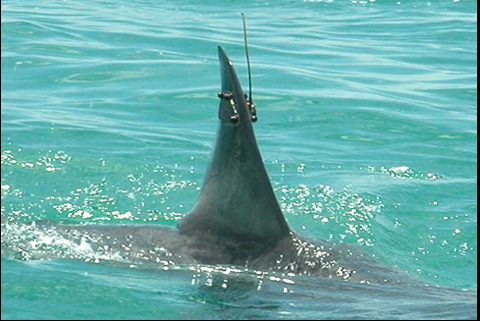
Local official in Zihuatanejo have started a study expected to last a year where they will be tagging hundreds of sharks and tracking the sharks via electronic radio device [Reuters link]. Biologists running the study will also also local fisherman to report back on any sightings, catches, or encounters with tagged sharks. Smaller sharks will be tagged with telemetric tags that reports location via radio emitting tag. This is a welcome change in their original response to the fatal shark attack in April where local authorities hunted and killed sharks in the area.

It’s good to see Mexico engaging in a thoughtful and well-design study that will provide useful data for the area and for science in general. Their initial response of hunting and killing sharks was short-sighted and ultimately back-fired as there were two additional attacks after the hunt.

Shark Tag

One response so far

May 29 2008

Blog Coverage of the Shark Attacks in Mexico

Published by under Mexico,Sharks

Troncones Surf Shop

The news coverage of the shark attacks in Zihuatanejo and Troncones, Mexico has been out of hand with pretty much every major news outlet and TV outlet adding to the feeding frenzy! Concierge did a good summary of the blog and news coverage here. It’s especially ironic considering how much a sleepy surf village Troncones is. One thing for sure, the line-ups in Guerrero are going to be empty now. So while scientists and reporter can debate whether global warming is to blame for the increasing global incidence in shark attacks, the fact is you’re more likely to die from a “collapsing sand hole incident” (yeah, I don’t really know what one is either) than from a shark attack (shark attack risk of death). So, if you want to score empty waves, now may actually be the best time to head down to Guerrero, Mexico (check out our guide to surfing the area of Guerrero and Michoacan). Your biggest struggles on a surf trip may more likely be from dealing with the logistics like getting scammed renting a car than with anything in the line-up. Regardless, don’t let it keep you out of the water and from exploring. Go surf!


2 responses so far

May 29 2008

American Surfer Injured in Shark Attack Plans to Surf Again

Published by under Uncategorized

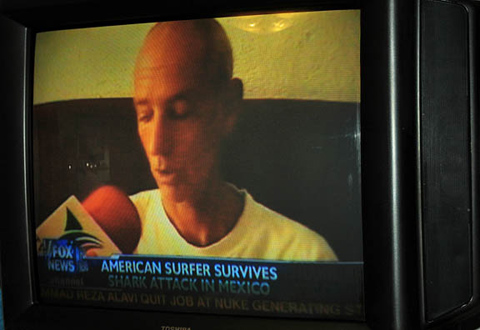
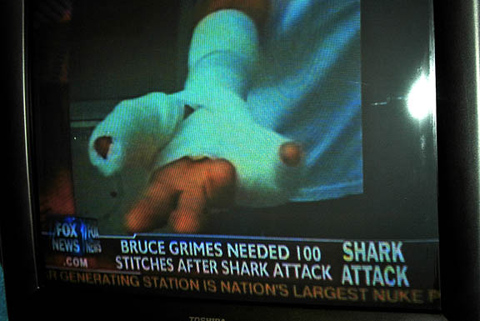
Bruce Grimes, a Florida surfer, who was recently injured in a shark attack in Zihuatanejo Mexico plans on paddling back on it the line-up after he recovers. Bruce had recently moved to Zihuatanejo and opened up a surf shop down there. He suffered injuries on his arm and received 100 stitches but did not lose his thumb as had been reported. Authorities in the area have responded by spotting at beaches by helicopter to watch for sharks.

“I’ll go right back. Yeah, I’m that stupid,” Grimes said, examining his bandaged arm outside the hospital where he just had his daily cleaning. “I’ll go right back out as soon as I’m able to.”

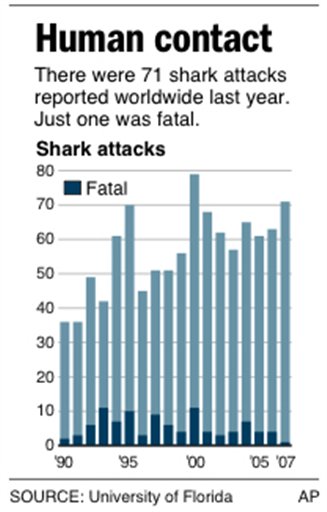
In spite of over 70 attacks in 2007, there was only one fatality worldwide. Already in 2008, there have three fatalities from shark attacks.

Bruce Grimes on FOX News

Bruce Grimes on FOX News

No responses yet

May 28 2008

Local Officials in Zihuatanejo and Guerrero, Mexico Alarmed at Recent Attacks

Published by under Mexico,Sharks

The recent shark attacks (and deaths) on surfers in the Zihuatanejo area of Mexico (state of Guerrero) has alarmed everyone in the area and even brought in the Mexican Marines and Navy to patrol and spot for sharks. So far, the Navy has reported not spotting any large sharks in the area; but locals remained concerned.

After the first shark attack in April, officials responded by hunting sharks in the area. There was a large backlash from environmentalist, tourist, and surfers. Unfortunately, the approach did not work as there were two additional attacks in the same area (one fatal). [See related posts below for more info] Local officials now are working hard at determining the species involved by catching and releasing them and trying to spot sharks instead of haphazardly hunting and killing them.

The attacks and recent press coverage is sure to dissuade travelers and surfers considering going to the area. Bruce Grimes, the American who was attacked on Sunday and lost his thumb to the attack, owns a surfshop in the Zihuatanejo area and is concerned about the effect of the attacks on business. In spite of his injuries, he’s planning a return to the water after his recovery.

“I’ll go right back. Yeah, I’m that stupid,” Grimes said, examining his bandaged arm outside the hospital where he just had his daily cleaning. “I’ll go right back out as soon as I’m able to.” [AP Press article]

Shark Attack Fatalities

One response so far

Next »